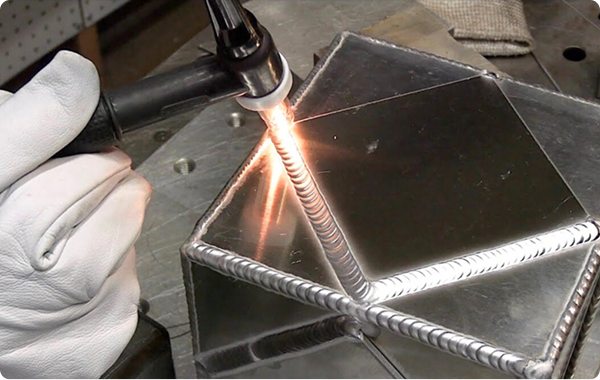
MIG / TIG Welding

Overview

MIG/TIG welding is a precision fabrication process used to join metal components through controlled arc welding while protecting the weld area with shielding gas. Both Metal Inert Gas (MIG) welding and Tungsten Inert Gas (TIG) welding are widely used across manufacturing industries to produce strong, reliable joints in a wide range of metals and alloys.

At Synertech PM, MIG and TIG welding are integrated into a comprehensive powder metallurgy manufacturing platform that supports the fabrication and finishing of complex components. 

Benefits of MIG/TIG Welding

Strong, durable joints

Arc welding processes create metallurgical bonds capable of withstanding demanding mechanical and environmental conditions.

Versatile material compatibility

MIG and TIG welding can be used with stainless steel, aluminum, titanium, copper alloys, and many other metals used in advanced manufacturing.

Speed and productivity with MIG welding

MIG welding’s continuously fed wire electrode allows for faster weld production and efficient fabrication of thicker materials.

Precision and control with TIG welding

TIG welding offers exceptional control over the weld pool, producing cleaner, higher-quality welds ideal for thin or intricate components.

Reduced finishing and post-processing

TIG welding often produces clean weld beads that require minimal finishing, improving production efficiency.

Adaptability to complex assemblies

Welding supports the fabrication of multi-component structures and assemblies that cannot be produced as a single piece.

Compatibility with powder metallurgy processes

Welding can be integrated with HIP, CIP, diffusion bonding, and powder metal consolidation to create finished components.

Applications Across Industries

MIG and TIG welding are essential joining processes used across industries requiring reliable metal fabrication and assembly.

Technical Details

Precise control of welding parameters and material preparation is essential to producing consistent, high-quality welds.

When specifying MIG or TIG welding for a project, engineers should consider the following technical parameters:

CategoryConsiderationEngineering Impact
Welding ProcessMIG (GMAW) or TIG (GTAW)Determines speed, precision, and material suitability
Electrode TypeMIG uses consumable wire; TIG uses non-consumable tungsten electrodeAffects weld quality, deposition rate, and control
Shielding GasTypically argon or argon mixturesProtects weld pool from atmospheric contamination
Material ThicknessMIG excels for thicker materials; TIG for thin sectionsInfluences weld penetration and process selection
Heat InputControlled through current, voltage, and travel speedCritical for preventing warping or distortion
Filler MaterialWire feed (MIG) or hand-fed filler rod (TIG)Ensures proper weld composition and strength
Joint DesignButt joints, fillet joints, lap jointsInfluences weld strength and fatigue performance
Surface PreparationCleaning and oxide removalEssential for preventing weld defects
Distortion ControlFixturing and heat managementMaintains dimensional accuracy
Inspection & QAVisual inspection, NDT testing, leak testingEnsures weld integrity and performance

The Synertech Approach

By combining welding with advanced powder metallurgy processes, Synertech PM provides customers with complete manufacturing solutions, from raw powder materials to fully assembled components.

Why Synertech Stands Out

Get great powdered metal parts built to spec—no matter how complex the design.

Partner with Synertech PM.