
Leak & Crack Detection
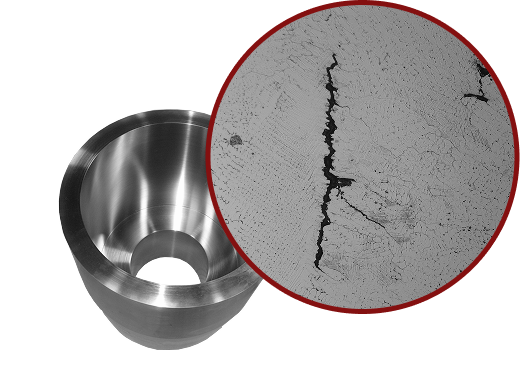
Overview
At Synertech PM, leak and crack detection is integrated into the manufacturing process to ensure that every component meets strict reliability and performance standards.
We perform in-house non-destructive testing (NDT) on capsule elements, welds, and finished parts to detect defects that may occur during fabrication or joining processes.
Using specialized inspection methods, such as helium leak detection, vacuum testing, and penetrant inspection, we can identify even extremely small defects that are invisible to standard visual inspection.
Key Benefits of Leak & Crack Detection
Early detection of structural defects
Identifying leaks and cracks during inspection prevents defective components from entering service and reduces the risk of operational failure.
Protection of critical systems
Even microscopic leaks can compromise high-pressure or vacuum systems, making precise leak detection essential for safety and performance.
Non-destructive testing methods
Inspection techniques allow engineers to evaluate structural integrity without damaging or altering the component being tested.
Improved weld and joint reliability
TIG welding offers exceptional control over the weld pool, producing cleaner, higher-quality welds ideal for thin or intricate components.
High-precision leak detection capability
Techniques such as helium mass spectrometry can detect extremely small leak rates by identifying helium tracer gas escaping from sealed components.
Reduced operational risk and maintenance costs
Detecting defects before deployment minimizes unexpected failures, downtime, and costly repairs.
Compliance with industry testing standards
Non-destructive inspection methods follow recognized testing standards to ensure consistent and repeatable quality control.
Applications Across Industries
Leak and crack detection is essential in industries where component integrity directly affects safety and performance.
- Structural aerospace components
- Engine and propulsion system hardware
- Lightweight assemblies and brackets
Aerospace & Defense
- Reactor and containment components
- Heat exchangers and pressure systems
- Power generation hardware
Energy & Nuclear
- High-pressure valves and fittings
- Pipeline components
- Downhole equipment
Oil & Gas
- Welded assemblies
- Powder metallurgy components
- Sealed mechanical systems
Industrial Manufacturing
- HIP capsules and powder containers
- Diffusion-bonded assemblies
- Vacuum-sealed components
Advanced Manufacturing
Technical Details
Proper inspection methods allow engineers to identify defects that could otherwise compromise component performance.
Engineers evaluating leak and crack detection methods should consider the following technical factors:
| Category | Consideration | Engineering Impact |
|---|---|---|
| Inspection Method | Helium leak detection, vacuum testing, penetrant inspection | Determines sensitivity and defect detection capability |
| Tracer Gas Testing | Helium commonly used as a tracer gas | Allows detection of extremely small leaks due to helium’s low atmospheric concentration and high mobility |
| Vacuum Environment | Parts may be tested under high vacuum conditions | Improves detection sensitivity for micro-leaks |
| Surface Crack Detection | Liquid penetrant or magnetic particle inspection | Reveals hairline cracks and surface defects |
| Material Compatibility | Ferrous and non-ferrous alloys | Influences which inspection techniques are most effective |
| Component Geometry | Size and shape of the part | Determines appropriate test setup and inspection method |
| Leak Rate Sensitivity | Measured in extremely small units of gas flow | Critical for vacuum systems and sealed components |
| Process Integration | Testing after welding, HIP, or diffusion bonding | Ensures defects are detected before final production |
| Standards Compliance | ASTM testing practices for NDT | Ensures consistent testing methodology and reliable results |
| Quality Verification | Documentation and inspection reporting | Confirms that parts meet engineering and safety requirements |
The Synertech Approach
Leak and crack detection is an integral part of our advanced manufacturing and quality control process. By combining precision inspection techniques with extensive powder metallurgy expertise, Synertech ensures that every component meets strict performance requirements.
Why Synertech Stands Out

In-House Non-Destructive Testing
Our team performs leak and crack detection internally on capsule elements, welds, and finished parts, allowing engineers to verify product integrity throughout the manufacturing process.

Advanced Inspection Technology
Using vacuum systems and helium leak detection equipment, Synertech can identify extremely small leaks that would otherwise be impossible to detect using conventional inspection methods.

Integrated Manufacturing Platform
We integrate leak and crack detection with complementary processes like HIP, CIP, machining, and welding to identify defects early and ensure consistent, high-quality components.

Trusted for Critical Applications
Synertech manufactures precision powder metal components used by organizations operating in some of the most demanding industries where reliability is essential, from aerospace to energy.
Get great powdered metal parts built to spec—no matter how complex the design.
Partner with Synertech PM.